Structural Drying and Dehumidification in Goose Creek, SC
Surfaces dry fast; framing, subfloor and slabs do not. The drying team sizes dehumidifiers and air movers to the loss and the humid air, then logs readings until every material reaches the dry goal.
LGR and desiccant dehumidifiers Psychrometric drying logs Dry reference readings
Right now
First steps for structural drying and dehumidification in Goose Creek
1
Keep windows closed
Humid outdoor air slows drying.
2
Run the AC if it was not part of the leak
Cool, dry indoor air helps the dehumidifiers.
3
Leave equipment running
Turning off air movers or dehumidifiers resets progress.
4
Keep doors to dry rooms closed
The drying team sets the space it is drying.
Structural Drying and Dehumidification: the trade facts
Water categoryAny, after removal
Typical drying3 to 7 days
Drying standardIICRC S500
Drying goal2 to 4 points of dry
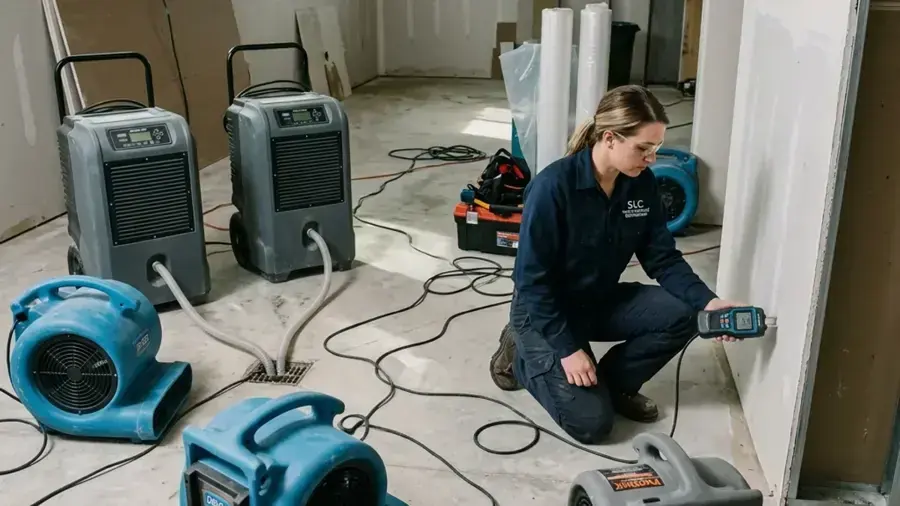
Structural drying is what turns a wet house into a dry one. After extraction, water is still inside drywall, framing, subfloor, slab concrete and the joists over a crawl space. In Goose Creek the outdoor air is humid much of the year, so opening windows adds moisture rather than removing it. The drying team closes the space and lets dehumidifiers pull the water out of the air while air movers pull it out of the materials.
How structural drying is handled
The tech who does the walkthrough maps every wet material and picks a dry reference material in the same building for comparison.
The drying team sets air movers by the room's evaporation load and LGR dehumidifiers by the class of loss; Class 4 losses in hardwood, plaster or slab get desiccant dehumidifiers or specialty drying.
Wall cavities get targeted airflow through small openings when the drywall can stay.
The crew records temperature, relative humidity and grains per pound every day, plus material readings, in a psychrometric log.
Typical cost ranges
What does structural drying and dehumidification cost in Goose Creek, SC?
In Goose Creek, SC, structural drying typically runs $1,000 to $9,000, depending on the class of loss, the number of rooms, the equipment needed and how many days the readings take to reach the goal.
Class 1 to 2, one area
$1,000 to $2,800
Air movers and LGR dehumidifier
Daily readings
Three to four days
Class 3, several rooms
$2,800 to $5,800
More air movers
Wall cavity drying
Psychrometric logs
Class 4, dense materials
$5,500 to $9,000
Desiccant dehumidifiers
Hardwood or slab drying
Extended monitoring
Ranges are typical figures, not a quote. The category of water, the square footage, the material class and how fast drying started move the number most. The Goose Creek water damage cost calculator gives a closer range.
Step by step
How structural drying and dehumidification is handled in Goose Creek
The tech who does the walkthrough finds the source and maps the moisture before equipment goes down, and the drying team keeps it running until the readings say dry.
1
Map
The walkthrough tech maps wet materials and sets a dry reference.
2
Set
The drying team places equipment by class and room load.
3
Log
The crew records psychrometric and material readings daily.
4
Finish
The drying team removes equipment when materials reach the goal.
01
Class 1 to 4: how much equipment a room needs
Class 1 is a small, contained loss with little absorption. Class 2 is a whole room with wet carpet and wall bottoms. Class 3 means walls, ceilings and floors all soaked. Class 4 means dense materials such as hardwood, plaster or concrete hold water deep inside. The class sets the number of air movers and the dehumidifier capacity.
Structural drying and dehumidification across Goose Creek and Berkeley County
The Goose Creek restoration crew covers ZIP 29445, from Crowfield Plantation and Sedgefield to Boulder Bluff, Liberty Hall, Carnes Crossroads and the homes off St. James Avenue and Red Bank Road.
Nearby coverage reaches Hanahan, North Charleston, Summerville, Ladson, Moncks Corner and Charleston.
Structural Drying and Dehumidification questions in Goose Creek, SC
What is structural drying?
Drying the building itself, framing, subfloor, slab and wall cavities, not just the surfaces, so moisture does not stay trapped inside.
Why not just open the windows?
Goose Creek air is often humid, so open windows bring moisture in. Closed rooms with dehumidifiers dry faster.
What does 2 to 4 points of dry mean?
Wet materials are dry when they read within 2 to 4 points of a dry reference material of the same kind in the same building.
How noisy is the equipment?
Air movers and dehumidifiers are loud and run day and night. Most families close doors to the drying rooms.
Can the equipment be turned off at night?
It should stay on. Turning it off lets moisture settle back and adds days.
Does insurance pay for drying?
Drying is usually part of the mitigation claim when the water came from a covered event. Coverage depends on your policy, so check with your own insurer.