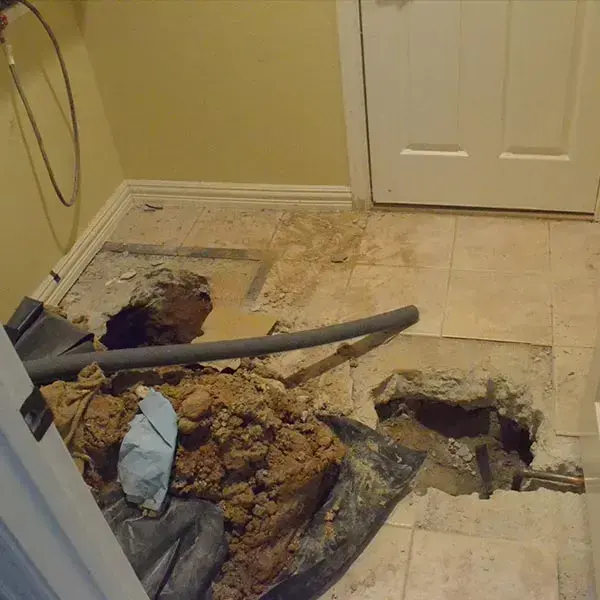
A pipe leaking beneath a concrete floor shows itself through warm tile, damp carpet or a climbing water bill. The Hanahan crew maps the moisture, removes wet flooring and dries the slab.
Close the main valve to see whether the signs stop, and keep it closed until checked.
2
Check for warm spots
Feel the floor for warm patches and listen for running water with all fixtures off.
3
Read the meter
Note the water meter reading, then check again after a quiet stretch with no water use.
4
Lift small items
Move rugs, boxes and furniture off the wet area.
Slab Leak Water Damage: the trade facts
Warning signsWarm floor spots, high bill
Hidden sourcePipe under concrete
Typical dryingSlabs dry slowly
Drying standardIICRC S500
A slab leak is a pipe leak you cannot see. Water escapes below a concrete floor and works its way upward through cracks, joints and the edges of rooms. In a house built on a slab, the first clue may be a warm patch, the sound of running water with every tap off, or a bill that jumps with no change in use.
What the water damages
Flooring: tile grout, laminate, hardwood and carpet pad all take water from underneath and lift or stain.
Baseboards and lower drywall: water wicks up the wall from the floor and softens the bottom of the board.
Cabinet bases: kitchen and bath cabinets sitting on the wet area can swell and delaminate.
The slab itself: concrete holds water, so moisture keeps rising into flooring long after the surface looks dry.
Typical cost ranges
What does slab leak water damage cost in Hanahan, SC?
A small wet area costs $1,800 to $4,000, one or two rooms run $4,000 to $8,500, and a long-running leak that spread through several rooms runs $8,000 to $14,000. The plumbing repair is billed as a separate job.
Small wet area
$1,800 to $4,000
Slab moisture mapping
Spot flooring removed
Local slab drying started
One or two rooms
$4,000 to $8,500
Flooring and pad lifted
Lower drywall cut out
Desiccant dehumidifier run
Leak that ran for weeks
$8,000 to $14,000
Wide flooring removal
Several rooms dried
Extended slab dry-out
Ranges are typical figures, not a quote. The category of water, the square footage, the material class and how fast drying started move the number most. The water damage cost calculator gives a closer range.
Step by step
How slab leak water damage is handled in Hanahan
The tech who does the walkthrough finds the source and maps the moisture before equipment goes down, and the drying team keeps it running until the readings say dry.
1
Map
Meters and a thermal camera outline the wet zone on the floor and lower walls.
2
Remove
Flooring, pad and baseboard that cannot dry are lifted and hauled out.
3
Dry
Desiccant units and air movers pull water from the slab and the room air.
4
Verify
Concrete readings are logged until they reach a dry level.
01
Finding the wet area
Slab moisture is not obvious. A moisture meter and an infrared camera trace the damp zone across the floor, which shows how much flooring has to come up. The plumber's leak detection tells where the pipe failed, and the two findings together set the plan.
02
Drying concrete takes patience
Concrete releases water slowly, and a closed-up room slows it more. Desiccant dehumidifiers pull moisture from the slab and the air together, with readings taken on the concrete until it reaches a dry level. New flooring laid over a damp slab traps the moisture and can ruin the new floor.
Slab leak water damage across Hanahan and nearby towns
Slab leak calls reach ZIP 29410, including Tanner Commons, Tanner Hall, Charleston Oaks, Mossy Creek and Ibis Glade, plus Eagle Bluff and the Bowen Village area.