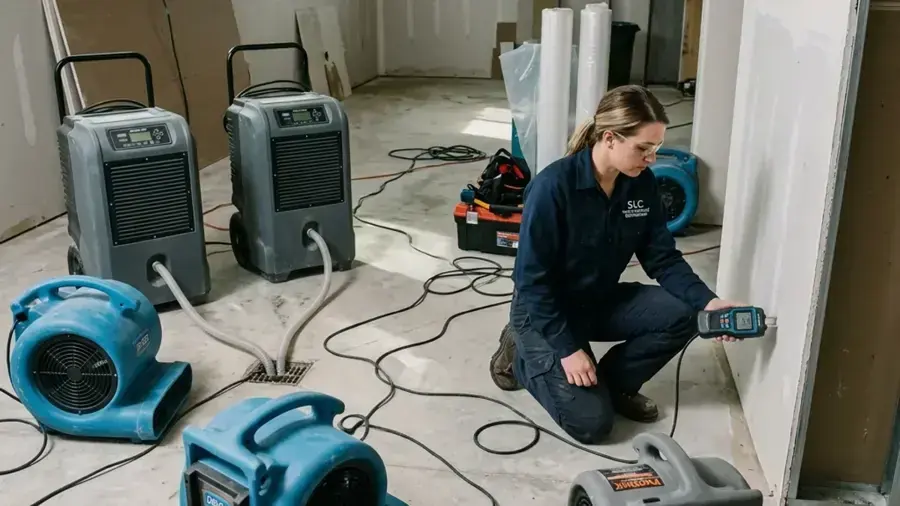
Structural Drying and Dehumidification in Summerville
Lowcountry humidity slows drying, so wet walls and floors need monitored equipment rather than open windows. Summerville crews place air movers and dehumidifiers and log readings until every material is dry.
LGR dehumidifiers Air movers Daily psychrometric logs
Right now
First steps for structural drying and dehumidification in Summerville
1
Remove the bulk water
Remove what bulk water can be reached, since less water dries faster.
2
Keep the house closed
Close windows and run the air conditioner so the equipment is not fighting outdoor air.
3
Leave equipment running
Keep it all running until the crew confirms dry readings.
4
Call for a plan
Dispatch sends a crew to size the equipment.
Structural Drying and Dehumidification: the trade facts
StandardS500 drying principles
EquipmentAir movers and dehumidifiers
MonitoringDaily moisture and humidity readings
Typical timeThree to four days or more
Water that has been pumped out is not gone. It stays inside wall cavities, under floors and within dense wood, and only controlled drying removes it. Without that step, wet framing carries odors, damages finishes and invites decay. Summerville's warm, humid climate makes open windows a poor drying method, since the air outside is often as damp as the air inside.
How drying is planned
Classing the loss from Class 1 to Class 4 based on how much water there is and how dense the wet materials are.
Placing air movers by wall length and floor area, with dehumidifiers sized to the cubic volume of the space.
Running low-grain refrigerant units for most losses and desiccant units for cold, dense or very wet materials.
Logging temperature, humidity and moisture readings every day and adjusting equipment as materials dry.
Typical cost ranges
What does structural drying and dehumidification cost in Summerville, SC?
Structural drying usually costs $1,000 to $9,000. Class 1 or 2 in one area stays at the bottom, Class 3 across several rooms lands in the middle, and Class 4 dense materials reach the top.
Class 1 to 2, one area
$1,000 to $2,800
Air movers and one dehumidifier
Daily readings recorded
Three to four days of runtime
Class 3, several rooms
$2,800 to $5,800
More air movers added
Wall cavity drying
Psychrometric logs kept
Class 4, dense materials
$5,500 to $9,000
Desiccant dehumidifiers run
Hardwood or slab drying
Extended monitoring period
Ranges are typical figures, not a quote. The category of water, the square footage, the material class and how fast drying started move the number most. The water damage cost calculator gives a closer range.
Step by step
How structural drying and dehumidification is handled in Summerville
The tech who does the walkthrough finds the source and maps the moisture before equipment goes down, and the drying team keeps it running until the readings say dry.
1
Classify
The loss is rated Class 1 to 4 by water volume and material density.
2
Place
Air movers and dehumidifiers go in by wall length and room volume.
3
Monitor
Temperature, humidity and moisture readings are logged every day.
4
Release
Equipment comes out only after every material reaches its dry standard.
01
Why monitoring matters
Daily readings show whether the equipment is working. If a reading stalls, the crew moves air movers, opens another cavity or adds capacity. Pulling equipment too early risks wet framing sealed behind new drywall, and that is where later odor and decay start.
02
Hardwood, concrete and walls
Dense materials dry slowly. Hardwood is dried with mats and gentle airflow so boards do not crack, concrete needs dehumidifiers that pull moisture out of the slab over days, and wall cavities are dried by opening small gaps or running air through them.
Structural drying and dehumidification across Summerville and nearby towns
Structural drying covers ZIP codes 29483, 29485 and 29486, including Cambridge Park, Heron's Walk, Homecoming, Parker's Preserve, Pine Hill Business Park and addresses along Ashley River Road.