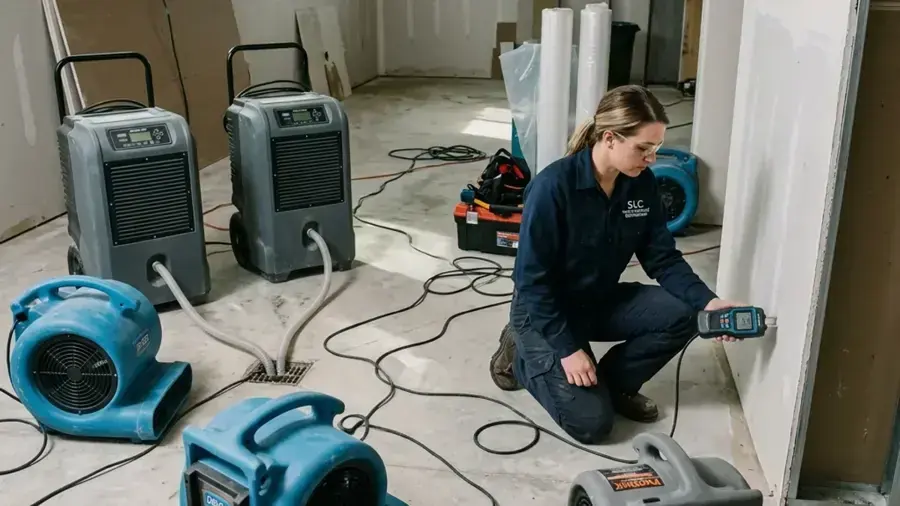
Structural Drying and Dehumidification in Charleston, SC
Muggy coastal air slows evaporation, so wet framing and floors need controlled drying. Air movers and dehumidifiers run on a plan, and daily readings show when each material reaches its dry goal.
LGR dehumidifiers Air mover placement Daily moisture logs
Right now
First steps for structural drying and dehumidification in Charleston
1
Leave equipment running
Equipment runs around the clock, so do not unplug it.
2
Keep doors and windows shut
Closed rooms let dehumidifiers pull moisture instead of fresh humid air.
3
Clear the airflow
Keep furniture and boxes away from air movers and wall openings.
4
Log your own notes
Write down new stains, smells or damp spots for the technician.
Structural Drying and Dehumidification: the trade facts
StandardIICRC S500
EquipmentAir movers, LGR, desiccant
TrackingDaily moisture logs
Ends whenReadings reach the dry goal
Drying is a science, not a fan in a room. Water moves into framing, subfloor and wall cavities, and a trained technician places equipment to pull it back out. In humid Charleston weather, the air itself holds moisture, so dehumidifiers matter as much as air movers.
How drying equipment is chosen
Air movers push dry air across wet surfaces and into wall cavities through small ventilation holes.
LGR dehumidifiers pull moisture from the air so the water leaving the structure has somewhere to go.
Desiccant dehumidifiers handle dense materials such as hardwood and concrete that hold water longest.
Thermal and moisture meters check what the eye cannot see inside walls and under floors.
Typical cost ranges
What does structural drying and dehumidification cost in Charleston, SC?
Light moisture in one area costs the least. Several rooms or a Class 3 loss add equipment and monitoring days, and dense materials such as hardwood and slab sit at the top because they need desiccant units and longer logs.
Class 1 to 2, one area
$1,000 to $2,800
Air movers and LGR dehumidifier
Daily readings
Three to four days
Class 3, several rooms
$2,800 to $5,800
More air movers
Wall cavity drying
Psychrometric logs
Class 4, dense materials
$5,500 to $9,000
Desiccant dehumidifiers
Hardwood or slab drying
Extended monitoring
Ranges are typical figures, not a quote. The category of water, the square footage, the material class and how fast drying started move the number most. The water damage cost calculator gives a closer range.
Step by step
How structural drying and dehumidification is handled in Charleston
The tech who does the walkthrough finds the source and maps the moisture before equipment goes down, and the drying team keeps it running until the readings say dry.
1
Survey
Meters and infrared cameras map wet materials and set the drying class.
2
Place
Air movers and dehumidifiers are sized to each room and cavity.
3
Monitor
Technicians return to log temperature, humidity and material readings.
4
Release
Equipment leaves once every reference reading hits the dry goal.
01
Water classes and drying time
Class 1 and 2 jobs involve limited wet materials, while Class 3 and 4 jobs involve saturated structure or dense materials such as hardwood and slab. The class sets the equipment count and the length of the dry-out, which readings then confirm.
02
Reading the logs
Each visit records temperature, humidity and the moisture content of reference materials. Those psychrometric logs show the dry-out progressing, and they give the insurer a way to verify the job without visiting the property. Final readings are taken after the equipment is shut off to confirm the numbers hold.
03
Preservation and permit steps
Homes with Historic Charleston Foundation or Preservation Society of Charleston easements may face permit steps before repairs, and the City of Charleston Permit Center handles building permits. Related pages include water extraction and storm water damage.
Charleston, SC service area
Service area
Structural drying and dehumidification across Charleston and nearby towns
Structural drying covers ZIP 29401, 29403 and 29412 across the peninsula and mainland, including South of Broad, Ansonborough, James Island, West Ashley, Avondale, Hampton Park and Daniel Island.
Structural Drying and Dehumidification questions in Charleston, SC
Why do the machines run so long?
Water hides in framing and subfloor, and dense materials release it slowly. Equipment stays until readings match dry reference values, not for a fixed number of days.
Can I use the air conditioner during drying?
Usually the crew advises running it at a steady setting or leaving it off, depending on the room. Closed doors and windows help the dehumidifiers work best.
Will the equipment raise my power bill?
Yes, a dry-out uses significant power. Insurers often consider the usage part of the claim, so keep the bill and ask the adjuster how it is handled.
Is the noise normal?
Air movers and dehumidifiers are loud, but the noise ends when readings reach the target. Technicians can adjust placement to limit disruption.
Do historic buildings dry differently?
Thick wood and layered floors can hold water longer, so the crew uses gentler drying and more checks. Preservation easements may add permit steps.
Water left inside framing and subfloor keeps causing damage after the surface looks fine. The drying team sets equipment, tracks readings and releases the job only when it is dry.